Coverage, code, and fire authority review
Fire professionals evaluate whether the system concept matches local wildfire risk, fire department access, water duration, defensible-space rules, and applicable requirements.
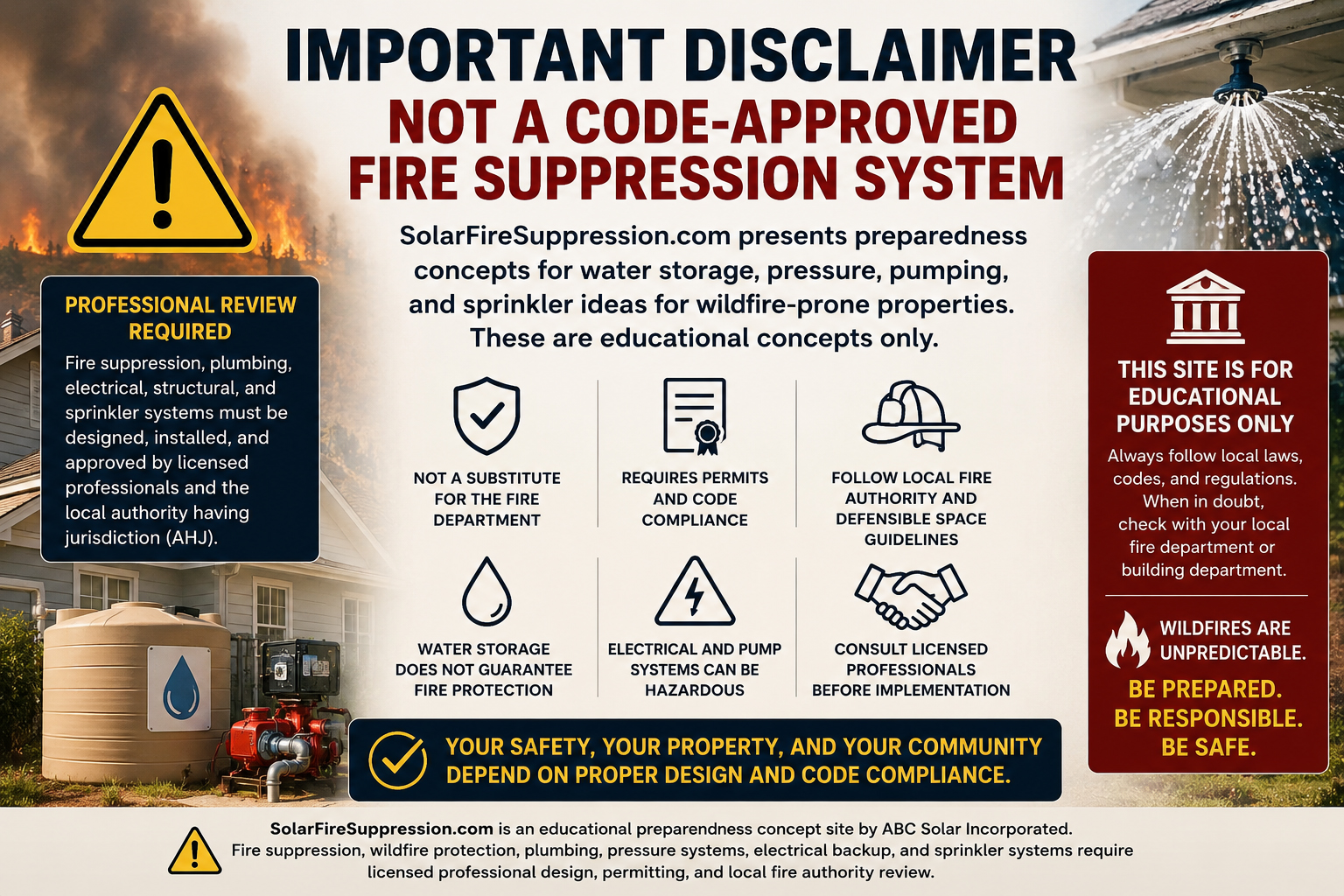
SolarFireSuppression.com presents educational wildfire water-readiness concepts only. It is not a code-approved fire suppression system, not a fire sprinkler design, not a fire department system, and not a substitute for evacuation.
SolarFireSuppression.com explores the relationship between water storage, pressure, solar-backed pump power, batteries, sprinkler concepts, and wildfire readiness. That exploration can be useful, but it must stay inside the correct boundary.
A real fire protection system is designed to applicable codes, reviewed by qualified professionals, permitted where required, installed using approved equipment, inspected by authorities, maintained, and tested. A website article is not that process.
Wildfire water readiness crosses multiple disciplines. That is why casual installation, handyman improvisation, and internet-only design are dangerous.
Fire professionals evaluate whether the system concept matches local wildfire risk, fire department access, water duration, defensible-space rules, and applicable requirements.
Plumbing and pressure systems involve cross-connection risk, contamination risk, relief valves, pipe ratings, suction hazards, freeze exposure, and safe discharge paths.
Pumps, batteries, inverters, wet locations, wiring, disconnects, grounding, breakers, transfer equipment, and controls require qualified electrical design.
A water readiness concept should reduce risk. Poor design can add risk: pressure failure, contamination, electrical shock, pump damage, roof leaks, false confidence, blocked evacuation, or unsafe operation during fire conditions.
Pressurized tanks store energy. Incorrect tank ratings, missing relief valves, bad fittings, corrosion, overheating, freezing, or unsafe mounting can create serious hazards.
Pool water, tank water, pond water, and domestic water must not be cross-connected without proper professional safeguards and backflow protection.
Pumps, batteries, inverters, outlets, controllers, and wet conditions are a serious mix. Improvised power connections can create lethal hazards.
Pool, pond, tank, and pump intakes can create suction hazards, clogging, priming failure, air ingestion, pump damage, or entrapment risk.
Roof piping, brackets, sprinklers, hoses, and water loads can create leak, attachment, drainage, wind, and fall-protection problems.
The most dangerous failure may be psychological: equipment that convinces someone to stay behind when leaving is the safer decision.
Water readiness should make pre-fire preparation stronger. It should not turn a property owner into a firefighter, encourage roof work in smoke, delay animal evacuation, or create a reason to stay.
Wildfire conditions can change faster than equipment can respond. Wind, embers, smoke, road closures, falling power lines, pump failure, reduced visibility, and panic can defeat even well-planned systems.
The responsible use of SolarFireSuppression.com is to help frame questions, identify risks, and prepare for qualified review.
“What stored water do we have, and what professionals should review it?”
“Which pump loads would need solar battery backup during a utility shutoff?”
“Where could water readiness support defensible-space work without replacing it?”
“I saw a page online, so I can build my own fire suppression system.”
“I have sprinklers and batteries, so I can stay longer during evacuation.”
“A garden hose, pool pump, and app-controlled valve make my house protected.”
Wildfire readiness is local. The rules, hazards, water availability, access conditions, fire department expectations, building code requirements, insurance concerns, and evacuation procedures vary by jurisdiction.
A concept that sounds useful on one property may be unsafe, illegal, ineffective, or misleading on another property. Local review is not red tape. It is the safety filter.
What does the local fire authority allow? Is the concept treated as preparedness, irrigation, auxiliary water, fire protection, or something else? What permits or inspections are required?
What water source is being used? Is it potable, pool, tank, pond, well, or reclaimed water? What backflow, filtration, sanitation, or cross-connection safeguards are required?
Are tanks, pipes, valves, hoses, pumps, fittings, gauges, relief devices, and supports rated for the pressure, environment, temperature, and duty cycle?
Are pumps, batteries, inverters, critical-load panels, breakers, disconnects, transfer equipment, grounding, wiring, labels, and wet-location protections correct?
Who tests the system? How often? Are instructions visible? Are valves labeled? Are batteries checked? Are filters cleaned? Are nozzles and hoses maintained?
Does the system make it easier to leave safely, or does it tempt someone to stay? What is the clear decision trigger to evacuate?
The pressure-tank, pump-bank, stored-water, and solar-backed readiness concept.
Pools, tanks, wells, cisterns, ponds, and water-source planning questions.
Pressure, flow, pump duty, relief valves, ratings, and mechanical safety.
Why water readiness must never become permission to stay behind.