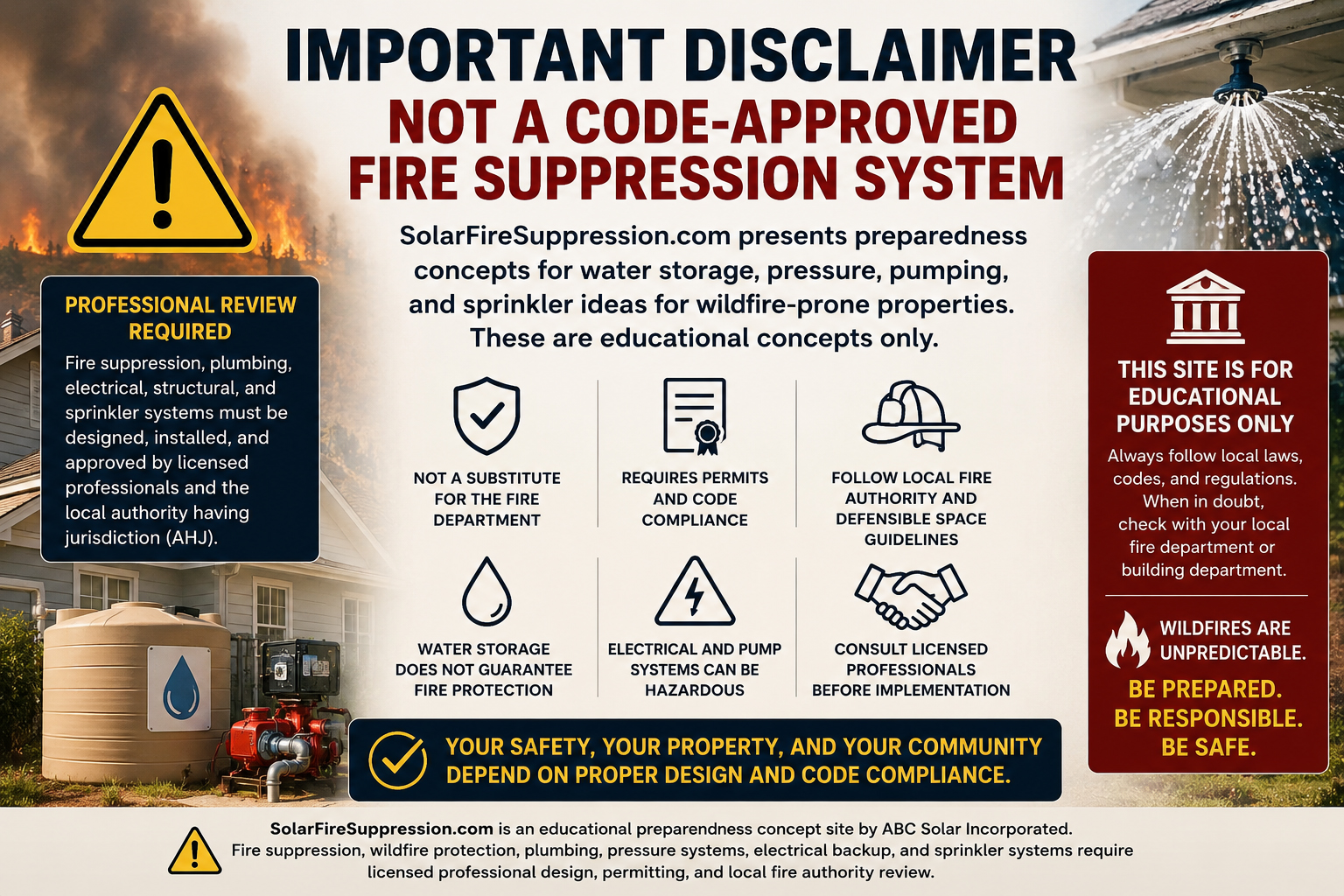
No. SolarFireSuppression.com is an educational preparedness concept site. It explores water storage, pressure tanks, pumps, sprinklers, solar backup, and wildfire readiness. A real fire suppression system requires code-compliant design, permitting, listed equipment, inspection, maintenance, and local authority approval.
FAQ
Questions before the smoke.
SolarFireSuppression.com answers practical questions about stored water, pressure tanks, solar-backed pumps, pool reserves, sprinklers, defensible-space water, and the safety limits that must stay clear on every page.
This FAQ is educational only. It is not fire protection engineering, not a fire-code approval,
not installation advice, and not a substitute for evacuation or local fire authority guidance.
Start here
The most important answer
SolarFireSuppression.com is about preparedness conversations. It is not a certified fire suppression system, not a sprinkler design, and not a reason to stay behind during wildfire conditions.
General questions
What is SolarFireSuppression.com?
No. These pages are not construction documents, engineering drawings, plumbing instructions, electrical instructions, fire sprinkler designs, or permit plans. Use them to prepare questions for licensed professionals and local authorities.
The site addresses a practical readiness gap: many properties have water nearby, but they may not have a safe, tested, powered, code-reviewed way to move that water where it could support preparation.
The Solar Fire Drum is a concept built around stored water, pressure tanks, a small pump bank, solar-backed pump power, and controlled water delivery planning. It is a concept only, not a certified fire-code system.
Water questions
Stored water, pools, tanks, and hot tubs
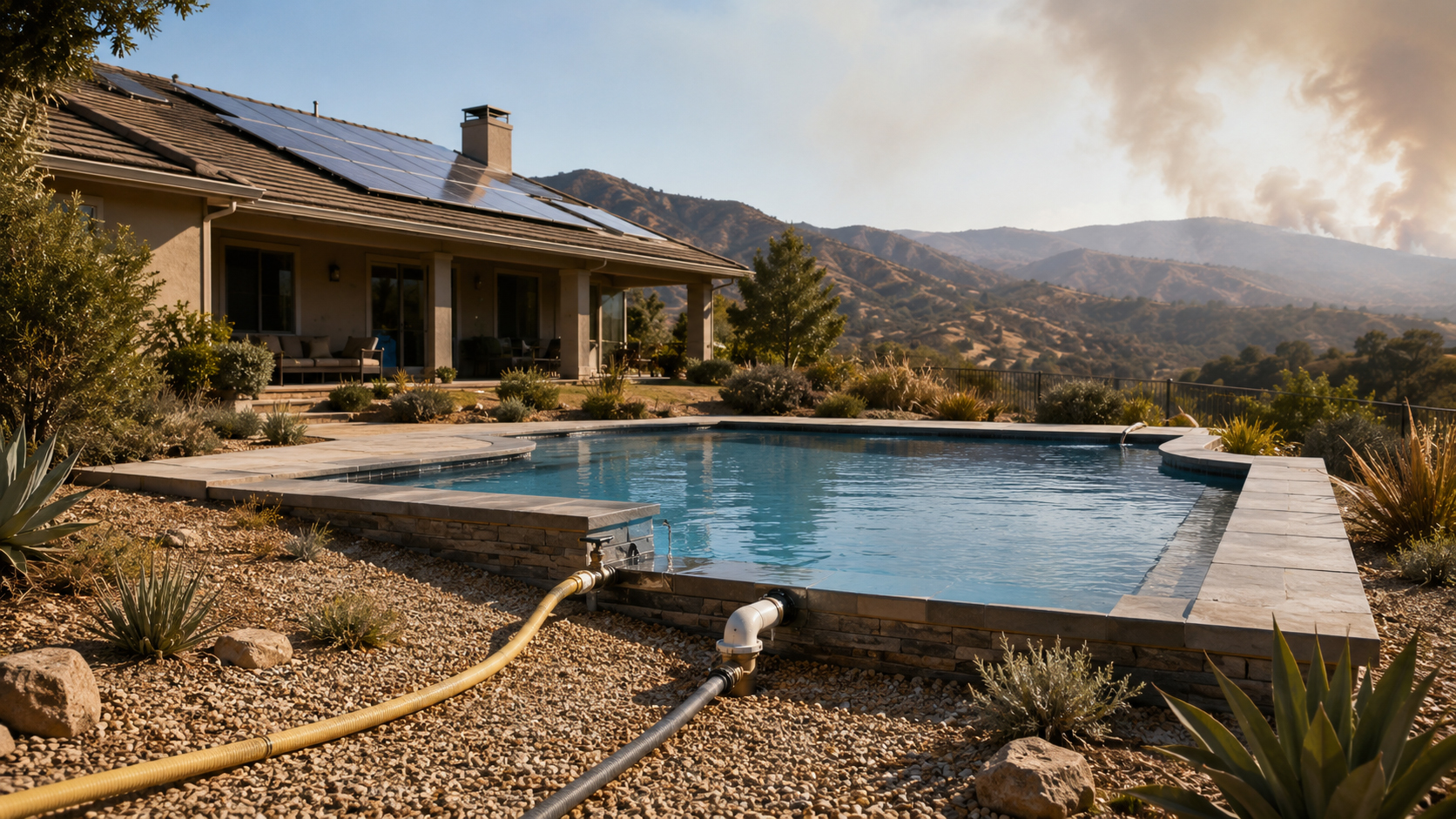
A pool may be part of a preparedness conversation because it can hold many gallons. But safe access is the hard part. Suction safety, pump sizing, filtration, electrical safety, backflow protection, local rules, and professional review matter.
A hot tub holds far less water than a pool, but it may still be part of limited planning. Spa water creates different concerns: heat, chemical concentration, tight equipment spaces, wet electrical areas, and lower total volume.
Dedicated tanks can be easier to plan around because outlets, valves, access, structural support, and maintenance can be designed intentionally. They still require proper sizing, support, plumbing, pressure, backflow, and local review.
No. Water that cannot be safely drawn, filtered, pumped, powered, and delivered at useful flow and pressure may not help. Stored water is one part of a larger readiness chain.
Pool Dragon’s answer
The water is not the plan. The plan is the path.
The site’s Pool Dragon character teaches the simple rule: backyard water becomes useful only when the access, pump, filter, power source, pressure, plumbing protection, and safe operating procedure are reviewed before fire season.
Pump and power questions
Pumps, pressure, batteries, and solar backup
A water system fails if the pump cannot start, cannot run, cannot produce useful flow, or cannot deliver pressure at the real outlet.
Maybe, but not automatically. The pump load, startup surge, voltage, inverter capacity, battery size, wiring, transfer method, and runtime must be designed as a complete electrical system. Smoke and ash can also reduce solar production.
Pumps are not just “on or off.” They have flow curves, pressure limits, startup surge, continuous load, duty cycle, priming requirements, suction limits, filters, valves, and thermal limits. Guessing can create failure or hazards.
Many pumps require more power to start than to run. A battery inverter may run lights, Wi-Fi, and small appliances but still fail to start a pump. Surge capacity must be confirmed.
Pressure tanks can provide stored pressure, but they do not replace correct pump sizing, safe tank ratings, relief valves, gauges, maintenance, and refill capacity. Pressure tanks store energy and must be respected.
Sprinkler questions
Roof, yard, and perimeter sprinkler concepts
Not automatically. Roof sprinklers may support a preparedness discussion, but useful performance depends on coverage, pressure, flow, wind, drainage, roof type, attachment, maintenance, water duration, and local fire authority review.
A dramatic spray can look impressive while missing the gutter, roof edge, deck, fence line, or ember-risk area. The question is where the water lands, how much arrives, and for how long.
No. Water readiness should support defensible-space work. It does not replace clearing debris, cleaning gutters, managing vegetation, reducing ember risks, hardening openings, or following local fire authority guidance.
Test the actual water source, pump, battery or power source, hose, pipe, valves, sprinkler nozzles, pressure at the outlet, water duration, wind behavior, dry spots, and manual fallback procedures.
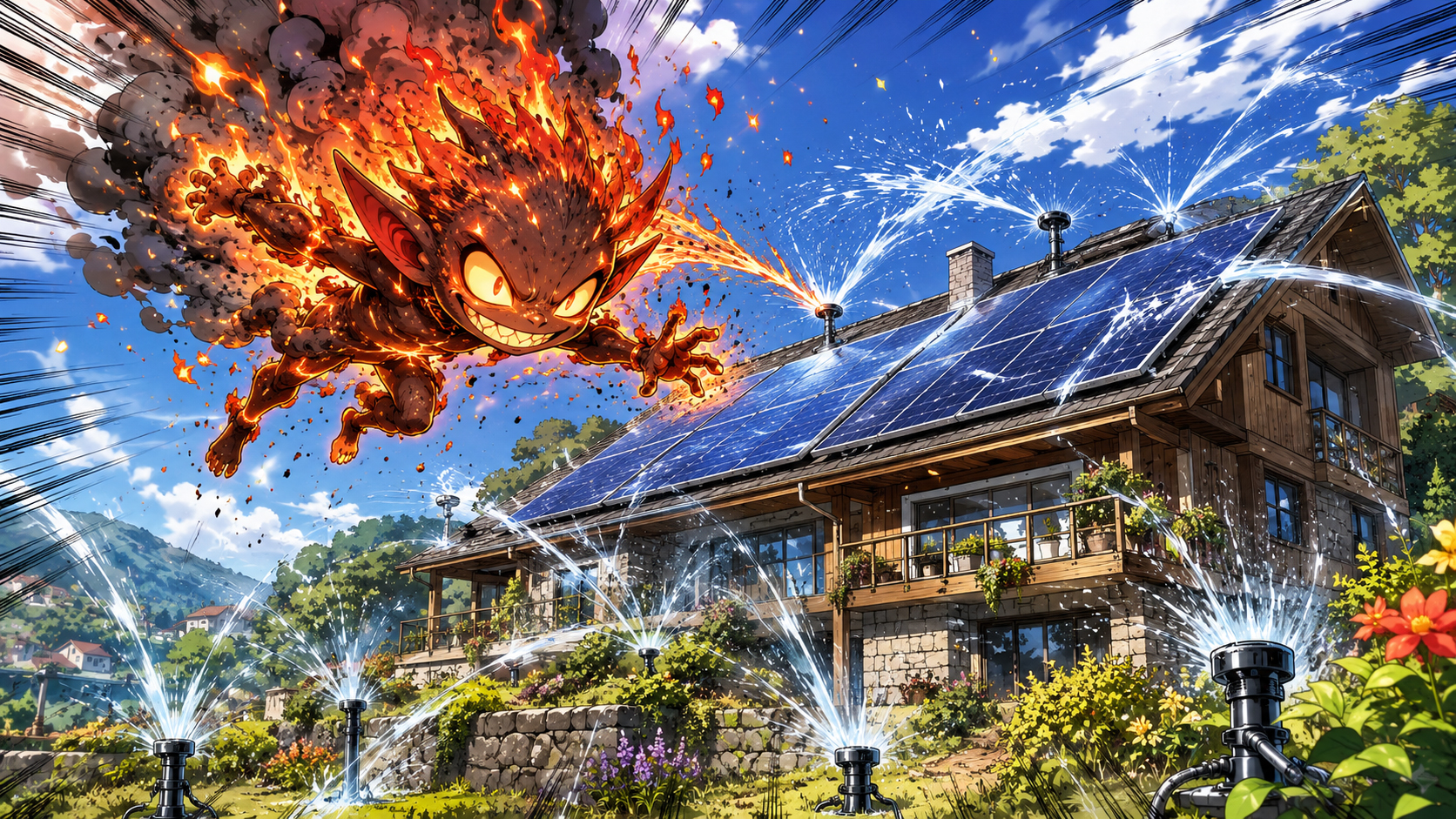
Ember Goblin’s answer
Water cannot clean a gutter you ignored.
The manga villain is small because embers are small. He looks for dry leaves, deck gaps, fences, vents, mulch, patio clutter, and roof-edge debris. Water readiness is strongest after the fuel problem is reduced.
Safety and legal questions
Codes, professionals, and evacuation
Depending on the concept, review may involve fire protection professionals, licensed plumbers, licensed electricians, solar and battery professionals, structural professionals, the building department, the fire authority having jurisdiction, the utility, and the insurer.
Backflow protection prevents contamination and unsafe cross-connections. Pool water, tank water, pond water, and domestic water cannot be mixed casually. Plumbing systems require proper professional safeguards.
One major danger is false confidence. Equipment that makes someone delay evacuation can be more dangerous than no equipment at all. The site’s rule is evacuation-first.
ABC Solar can discuss solar, battery, critical-load, and pump-backup planning from an energy perspective. Fire suppression, plumbing, pressure, and sprinkler design still require appropriate licensed professionals and local authority review.
Keep reading
Best next pages
Solar Fire Drum
The core concept: water, pressure, pumps, batteries, and readiness.
Pool Reserve
How backyard water may become part of a reviewed readiness plan.
Sprinkler Concepts
Why coverage, pressure, wind, and duration matter.
Evacuation First
Why equipment must never delay leaving safely.